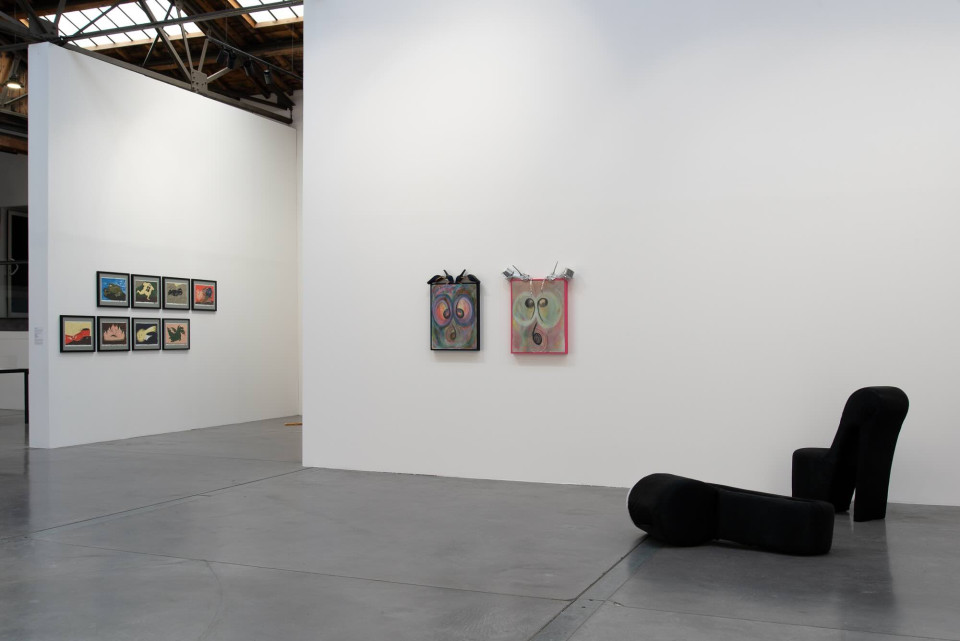
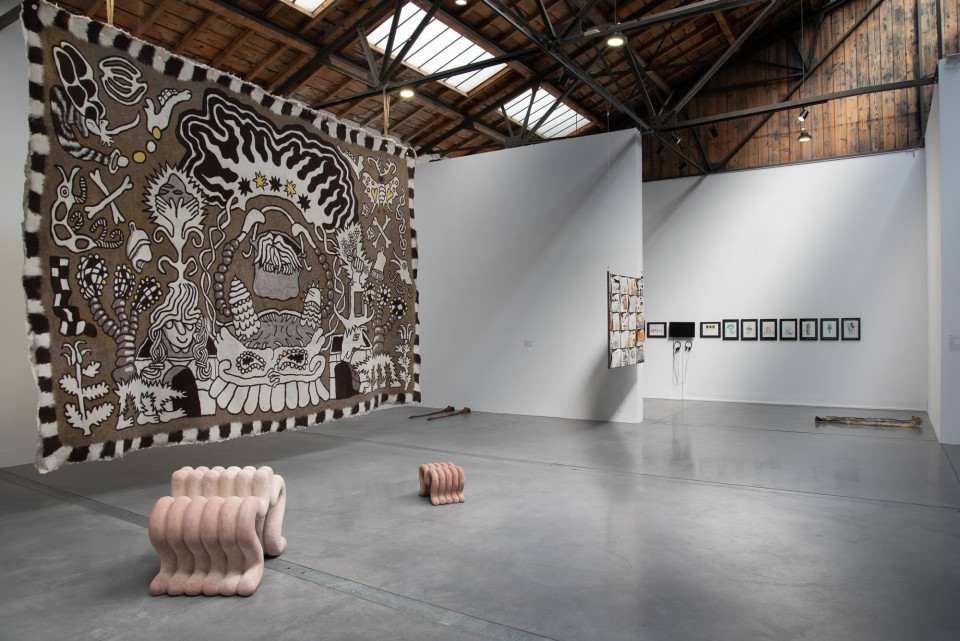
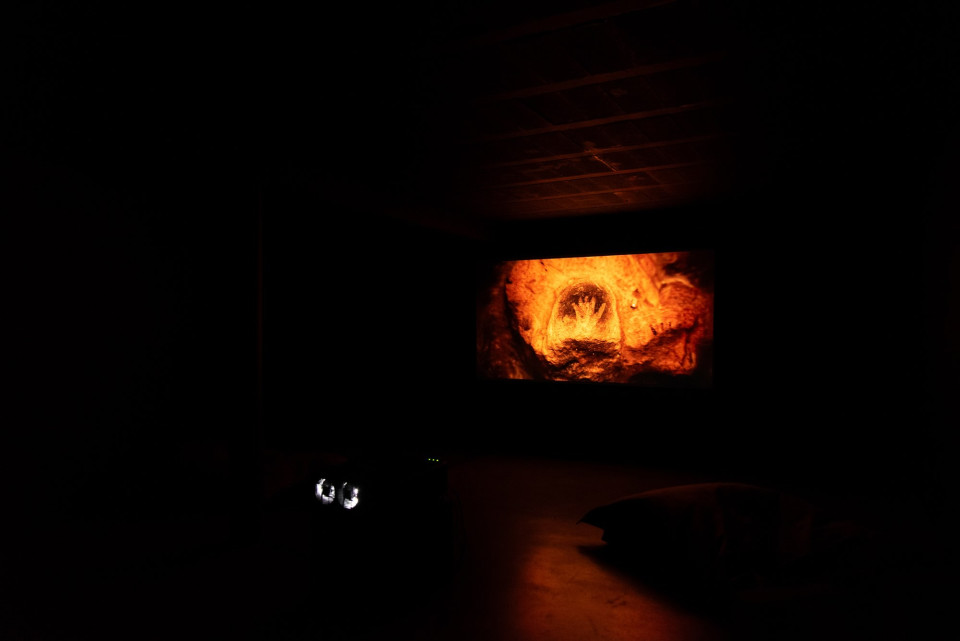
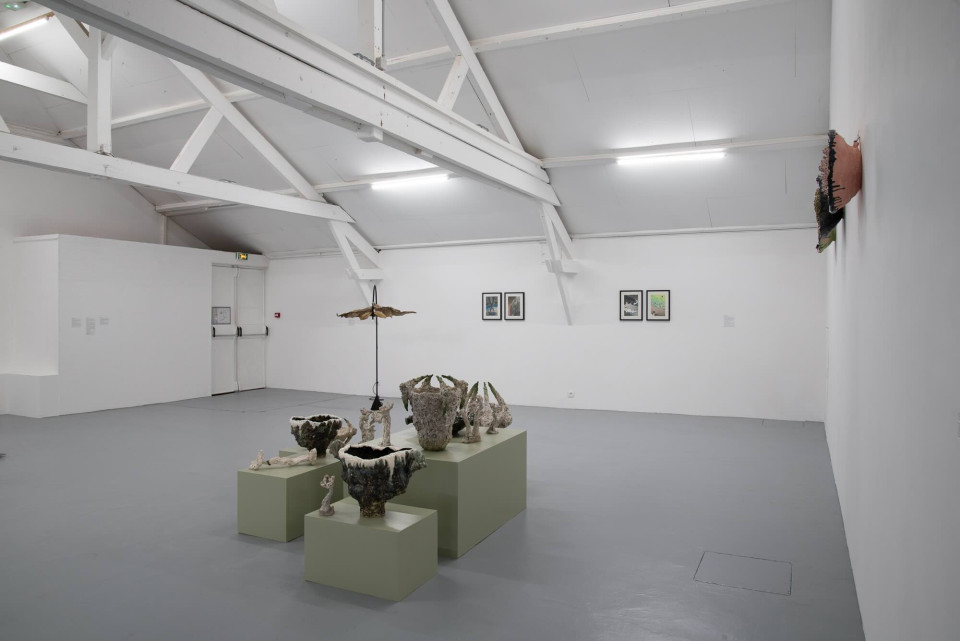
A collective exhibition
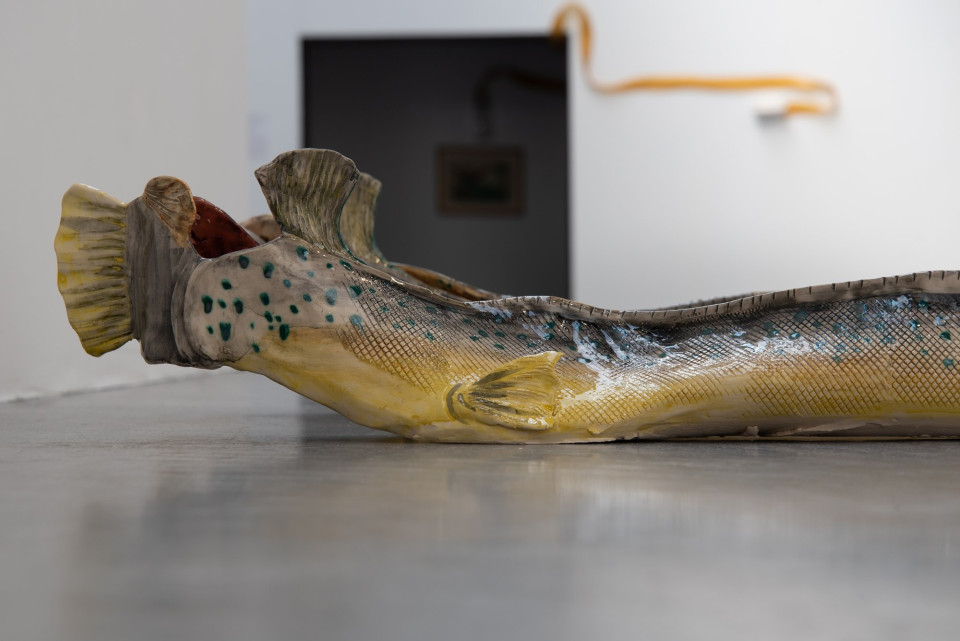
The Woman with Fish Arms
Exposition
with artworks by Pauline Barzilaï, Marie Bette, Rose-Mahé Cabel, Nicole Claveloux, Joris Creuze, Pauline Curnier-Jardin, ludovic hadjeras, Jenna Kaës, Clovis Maillet, Nitsa Meletopoulos, Hatice Pinarbaşi, Eva Pelzer, Théophile Peris, and Birgit Rathsmann.
with objects from the collections of the Montbéliard Museums, the Montbéliard Municipal Archives, and the ACEPU Le Châtelot.
Curator: Adeline Lépine
“In the language I’ve inherited from you, Bernese German, my mother tongue, ‘mother’ is meer. It means both ‘mother’ and ‘the sea’, sneak-tweaked from the French; la mer and la mère. For ‘father’, we say peer. For ‘grandmother,’ grossmeer. For ‘great-grandmother,’ urgrossmeer. The women of my childhood are an element, an ocean.” 1
In Montbéliard, as you climb the rocky outcrop leading to the castle, you are greeted by a coat of arms adorning the entrance gate. At the top of this coat of arms, you’ll notice a crest depicting a crowned female figure whose arms have been replaced by fishes. Rare in heraldry, this depiction is part of a broader family of female busts that are sometimes armless or whose arms are replaced by various types of appendages. Here, the fishes are two inverted and facing sea bass (bar in French) in gold, which refer to a play on words used to designate the coat of arms of the Counts of Montbéliard, descendants of the Counts of Bar since 1038.
Colored emblems governed by the rules of heraldry—known as coats of arms—emerged in Western Europe during the 12th century. In the context of a feudal society where knights competed in tournaments, this system of symbols was intended to identify individuals, families, and lineages, as well as communities and institutions. The crest is the distinctive element of the coat of arms: placed above the family shield, it conveys something about the person who chooses it to represent themselves. It most often symbolizes a virtue, a quality, or a physical characteristic with positive connotations. Traces of the sea basses alone in Montbéliard’s heraldry can be found in numerous documents from this period as the canting arms of the county of the same name. The crest, however, did not appear until 1340 on a seal of Henri de Montbéliard, Lord of Montfaucon, and would enjoy a long legacy, as it was incorporated into the coat of arms of the Countess of Montbéliard, Henriette d’Orbe-Montfaucon 2, who, through her marriage to Prince Eberhard IV of Württemberg, passed the crest on to this German aristocratic family. Finally “the woman with fish arms” is also featured on the coat of arms of the city itself.
The rules of heraldry developed over several decades, and even today it is difficult to pinpoint exactly when they first appeared. One hypothesis is that this system of symbols was inspired, at least initially, by other pictorial and symbolic representations of the time, particularly those derived from Roman art. Art historian Jurgis Baltrušaitis suggests that the attire of knights—and more specifically, the design of their helmets featuring crests—represents the fantastical figure of the grylle. 3 “Some warriors dress like genies with multiple faces and virtues. Others, by adorning their helmets with animal motifs, evoke certain horsemen of the Apocalypse. In parades and battles, living grylles spring up from all sides. 4”
Hybrids of women and fish, in particular, have been a source of inspiration since antiquity for the observations of the most discerning naturalists, as well as for the imagery that artists and poets love to evoke. In folklore, there are numerous tales featuring bodies transformed in and by the river. In Franche-Comté, a figure contemporary to this crest is the Vouivre: alternately a woman-snake, a woman-fish 5, or a winged serpent, she, like Melusine, maintains a connection to the river and the marshes—the environment that triggers her metamorphosis. In Montbéliard, she guards a treasure, a ruby, which she sometimes wears on her forehead. Female figures hybridized with fish or reptiles have commonly been associated in the collective imagination with the expression of the impure, the monstrous, or even the abominable6. Women associated with (and considered to be) these animals have been subjected to exclusion or discrimination due to their supposedly unbridled sexuality, potential greed, and possible immoral behavior.
It is this paradox of interpretations—ranging from fascination to rejection, and from contempt to desire—of figures that are nonetheless similar in form that inspired this group exhibition, which sets out to explore the mysteries of La Femme aux bras poissons through the works of fourteen contemporary artists and heritage objects. Taking as its starting point an examination of the concept of hybridity through contemporary issues, this figure serves as the anchor for a philosophical, aesthetic, and political reflection. Far from claiming to produce scientific knowledge, the exhibition functions as a framework for thought that allows us to explore new forms of engaging with heritage and to open up alternative imaginaries capable of producing new ways of existence inspired by the multiplicity of living beings.
//////
The exhibition La femme aux bras poissons* was made possible thanks to the support of the teams at the Montbéliard City Museums and the Montbéliard Municipal Archives, as well as the generous sharing of knowledge by Clovis Maillet and Perrin Keller.
The exhibition was produced in partnership with the Ibis Styles in Montbéliard for hosting the artists, the Martell Corporate Foundation for Marie Bette’s work, the Loegel Rothbach Quarry for Théophile Péris’s work, the Allondans City Hall for Rose-Mahé Cabel’s performance, Jean-Marc Lonjon for the works by Nicole Claveloux, the Factatory at Galerie Tator for the work by Joris Creuze, the Cadratem studio for the work by Ludovic Hadjeras, and Pôle Print – Collectif Bonus in Nantes for the work by Pauline Barzilaï.*
The artists would particularly like to thank:
Hatice Pinarbaşi: Kamal Cherkaoui, Olcay et Ali Akkoyun, Hugo Ferretto et la villa du Lavoir.
Pauline Curnier Jardin: Rachel Garcia, Vincent Denieul, Simon Fravega d’Amore, Maeva Cunci, Tobias Haberkorn, Aude Lachaise, Viviana Moin, Mickaël Phelippeau, Walkind Rodriguez, Alexis Kavyrchine, Damien Oliveres, Claire Vailler, D.A.A.D, Unit Moebius, JADA, Teiji Ito, Viola Thiele, Le Printemps de Septembre, Maison Européenne de la Photographie, Caza d’Oro, Dirty Business of Dreams, Den Frie (Kopenhagen / Copenhagen), Cobra Museum Amstelveen, Cultural French Ministry, Amodo Fondation, Ricard Fondation, Ellen de Bruijne PROJECTS.
Birgit Rathsmann: Gary Richards, Anna Drezen, Tim Platt, Ikechukwu Ufomado, Meade Bernard.
- Kim de L’Horizon, Sea, Mothers, Swallow, Tongues. Translated from the German by Jamie Lee Searle, 2025. ↺
- The crest appears on Countess Henriette’s cenotaph in the Collegiate Church of Stuttgart (see the drawing by André Rüttel from 1583, held at the Württembergische Landesbibliothek, hist.2° 130, 30r.) Henriette is a key figure in the history of the Montbéliard region, and her identity also takes on multifaceted and hybrid forms in folk tales. Indeed, Henriette is sometimes cited as the embodiment of Tante Airie, a good fairy from local folklore. ↺
- Grotesque creatures depicted since ancient times across various cultures (Scythian, Persian, Egyptian, Greek, Etruscan, Roman) which have multiple heads and/or are half-human, half-animal hybrids. Featured on coins, sculptures, paintings, and even gemstones, these creatures made their way into the Roman era, and medieval Europe adopted them, blending them with archaic Christian imagery. ↺
- Jurgis Baltrušaitis, Le Moyen Âge fantastique : antiquités et exotismes dans l’art gothique, Paris: A. Colin, 1955. English translation suggested by the author. ↺
- The figure of the Vouivre plays an important role in the folklore of Burgundy, Franche-Comté, and the Jura. The imagery she evokes has also inspired contemporary literature. For example, Marcel Aymé describes her as a woman living in the marshes who guards an enormous ruby in his 1943 fantasy novel, La Vouivre. ↺
- In her book, Purity and Danger: An Analysis of Concepts of Pollution and Taboo (1966), Mary Douglas examines how dirt and pollution have become central symbolic concepts for distinguishing between societies and religions, beings and non-beings, as well as order and disorder, and the pure and the impure. According to her, this systematic framework that defines the boundaries of impurity and pollution dates back to antiquity, particularly to the “abominations” described in Leviticus (historically dated to the 5th century B.C.), which specify which animals are considered abominations in relation to diet. Thus, fish that allow themselves to be carried along by the force of the current, just like reptiles that crawl on their bellies, are excluded because they symbolize indulgence, passions, and greed. ↺